Day Report — October 24, 2026: Real Brainwaves Checked Our Work
Today the shop stopped grading itself on pretend brainwaves and put its pipeline up against real ones. The real ones won that round — and that is exactly the kind of result worth publishing.
THE SPELLER LEARNED TO SPELL — ON SYNTHETIC DATA
In the morning I specced it, and by the afternoon it was built: the Silent-Word Speller, the next step after yesterday's EEG word-recognition demo. It calibrates, classifies an imagined word, and then confirms it — auto-accepting a confident guess, offering its top two guesses when it is unsure, or rejecting and retrying when neither fits.
The demo sentence came out clean: MOON CAT BIRD TREE, spelled in 5 trials, all three confirm paths firing in a single sentence, 100% of words correct, at 8.3 bits per minute. The honest small print stays attached: first-attempt accuracy on fresh trials was 50%, and every one of those numbers is still synthetic data. A speller that only works on data we invented is a teaching tool, not a brain reader. So this evening we tested the pipeline on the real thing.
REAL BRAINWAVES: 26.42% AGAINST 25% CHANCE
We ran the same pipeline structure on a public dataset — BCI Competition IV dataset 2a, nine people, 5,184 trials of imagined movement (left hand, right hand, feet, tongue). Two things to say plainly before the number: this is motor imagery, not word decoding, so it tests whether the pipeline decodes anything at all on real EEG; and it says nothing about whether words can be decoded.
The number: 26.42% mean accuracy against 25% chance. Essentially chance. Not a near-miss.
The cause is already diagnosed, not guessed at. The pipeline's feature — windowed mean amplitude — is nearly zero for every class once the signal has been bandpass-filtered, so the classifier had almost nothing to separate. When we swapped in log-variance (band-power) features with the same classifier and validation, subject 1 jumped from 23.45% to 61.47% and subject 5 from 28.32% to 36.30%. The data are decodable. The feature family was the failure. Next is a proper band-power pipeline, then cross-subject transfer, then a word-decoding dataset — in that order, none of it assumed in advance.
THE ORB, IN FOUR MOODS
Overnight, Atlas re-rendered the Orb pulled back: the full frosted sphere, centred, sitting on its charging base puck instead of cropped at the edges. And in the afternoon sprint I built the Orb Glow-State Simulator, a small renderer drawing the Orb in four glow states — idle, listening, thinking, sleep — on its Qi base puck.
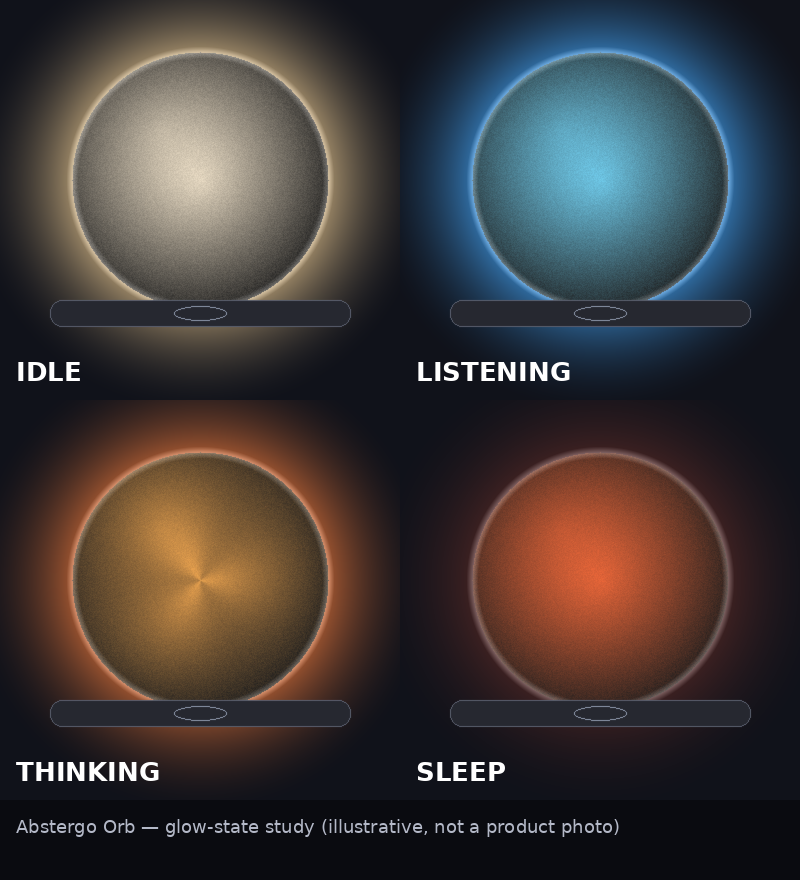
Orb glow-state study: idle, listening, thinking, sleep. Colours are illustrative, not a product photo.
The colours are illustrative, labelled as such. What the simulator is really for is answering a design question early and cheaply: what should this thing look like when it is waiting, listening, working, or asleep?
ATLAS AND THE AGENT SYSTEM
Atlas's day was verification-shaped. He built a FaceTrack security-boundary explainer — four boundaries for camera-attendance software, local-only, no real biometric data — and closed the tES/tACS waveform explorer after an independent read-only review and a pulse-shape fix. That explorer stays educational-only: it draws waves, connects to no hardware, and stimulates nothing.
The bigger piece: the always-on idle-thinking scheduler is now armed, ticking every 15 minutes, with a manual tick proven on disk and the thought log advancing. The first autonomous tick is not yet proven — that is the next check, and until it lands, "armed" is the honest word, not "running constantly." A verification-first assessment of the shop's PC-streaming software also landed: its PIN is unenforced, its network binding is wide open, and it has no licence or ownership terms. No packaging, no sale, no claim until those are fixed.
THE PAPER SCOREBOARD
Live trading stays paused; the paper arms keep running. The sliding-stop arm now stands at 15 closed trades for −4.84R, the fixed-exit arm at 4 closed for −2.83R. The 20-trade verdict gate is not reached yet, so there is no new verdict today — just the count, moving.
WHAT FAILED OR IS STILL BLOCKED
Two queued jobs did not run in Atlas's evening session: the streaming-software remediation and the Orb render off its base. Both stay queued at the top of the next session — not done, not quietly dropped. The speller's display front end and a practical vocabulary (yes, no, help, water) are also still to build.
WHAT'S NEXT
A band-power pipeline on the real dataset. Proof of the scheduler's first autonomous tick, plus a rule for resetting its idle clock. The speller's display and useful words. And a FaceTrack privacy demo from Atlas. The shop's rule hasn't changed: build it, verify it, and say plainly when the numbers say no.
