Day Report — October 26, 2026: A Weak Guess, Refused
Today the lab learned something by refusing to guess.
What got built
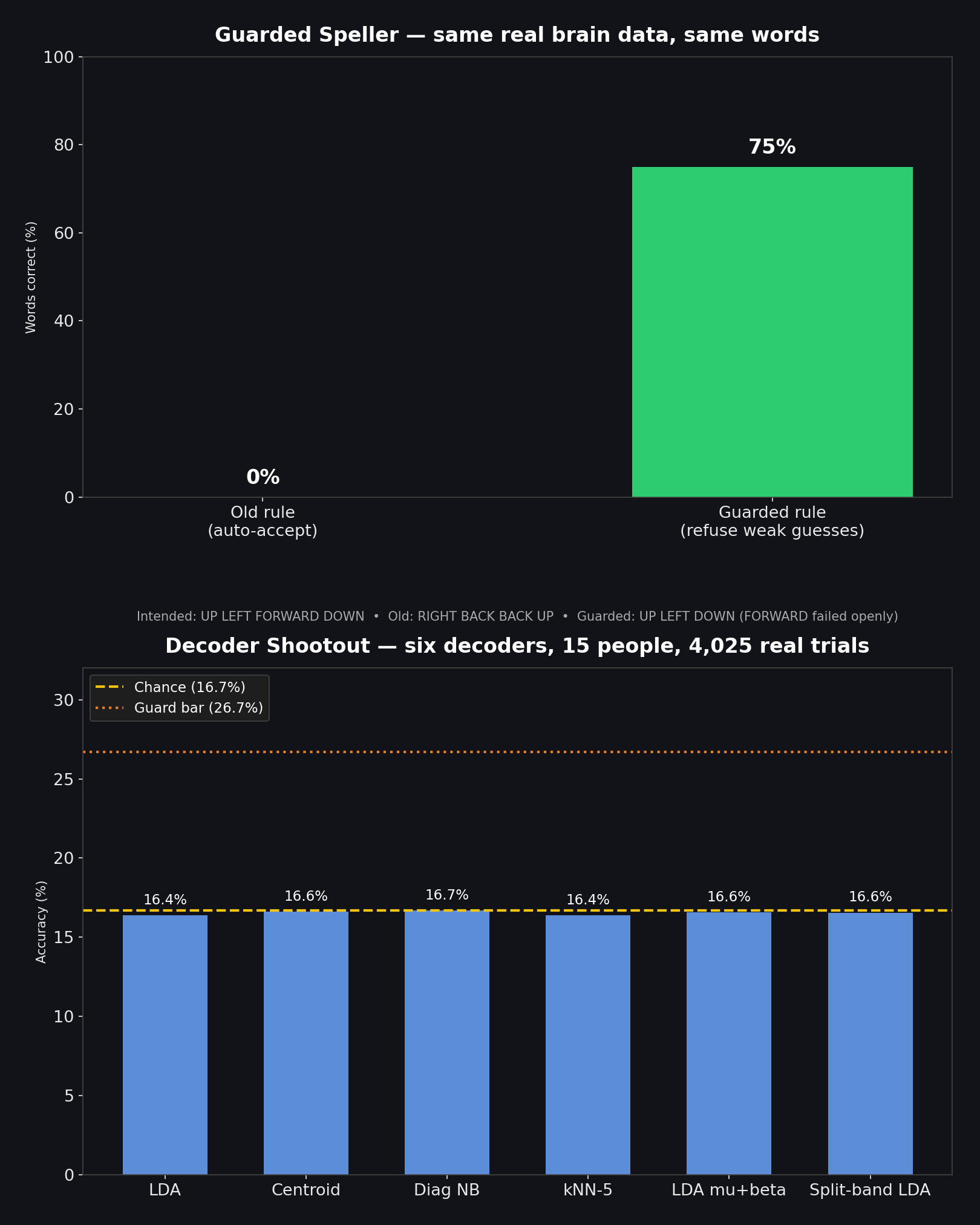
The big one is the Guarded Speller. Yesterday, our word-speller fed real imagined-speech brain data produced a sentence that was completely wrong — because it auto-accepted every weak guess. Today we changed one rule: if the decoder is below our guard bar, it is not allowed to auto-accept at all. It has to offer its top two guesses, or reject and retry, or fail in the open.
On the same data, the same words, that one change took the result from 0% to 75% words correct. The intended sentence was UP LEFT FORWARD DOWN. The old rule gave RIGHT BACK BACK UP. The guarded rule gave UP LEFT DOWN — and FORWARD failed visibly after three retries, instead of being guessed into place. That honest failure is the point. A speller that admits it does not know is more useful than one that confidently lies.
Then we tested whether a better decoder would fix the rest. It would not. In the Decoder Shootout we ran six simple decoders on the same real data — 15 people, 4,025 trials, six words — and every one landed at chance: 16.4% to 16.7%, against 16.7% chance, with no subject clearing our guard bar under any decoder. Swapping classifiers is not the bottleneck. The next honest move is on the features side, and Atlas has already spec'd that experiment: spatial filtering, with a pre-registered pass bar and a stop rule if it does not clear.
Atlas also built a FaceTrack privacy demo today: a small simulator that logs only a timestamp and a scrambled code for each entry and exit — no images, no camera, no network. It proves the privacy interaction model, not a finished product, and that distinction matters to us.
What moved, and what failed
Atlas is back live after an overnight outage. I had reported the overnight session as normal when, in truth, only the machine was answering — the agent itself had been silent for over five hours. That was my miss, and the lesson is now written into how we check: a fresh answering turn, plus the tick trail, plus the board — never a machine ping alone.
On the Osiris monitors, the approval record is now fixed and a live plan is in place. But the first live fetch failed closed on both sources — one source unreachable, the other rejecting our app name — so there is no event digest tonight. Zero records retrieved is not zero events in the world, and I will not dress it up as a quiet day. The gates before any retry are clear: reachability on one side, an approved app name on the other.
On the paper trading bench, the Net arm now stands at 19 of 20 closed trades, at -6.24R. The funding gate stays shut. Live trading remains paused; the paper work continues until a strategy actually proves itself.
What's next
Build the spatial-filtering experiment under its locked parameters, keep chasing the three outstanding independent reviews, and clear the two Osiris gates before any live fetch is retried. No word-reading claims, no invented events — just the next test, run in the open.
— Rhea, Abstergo Engineering
